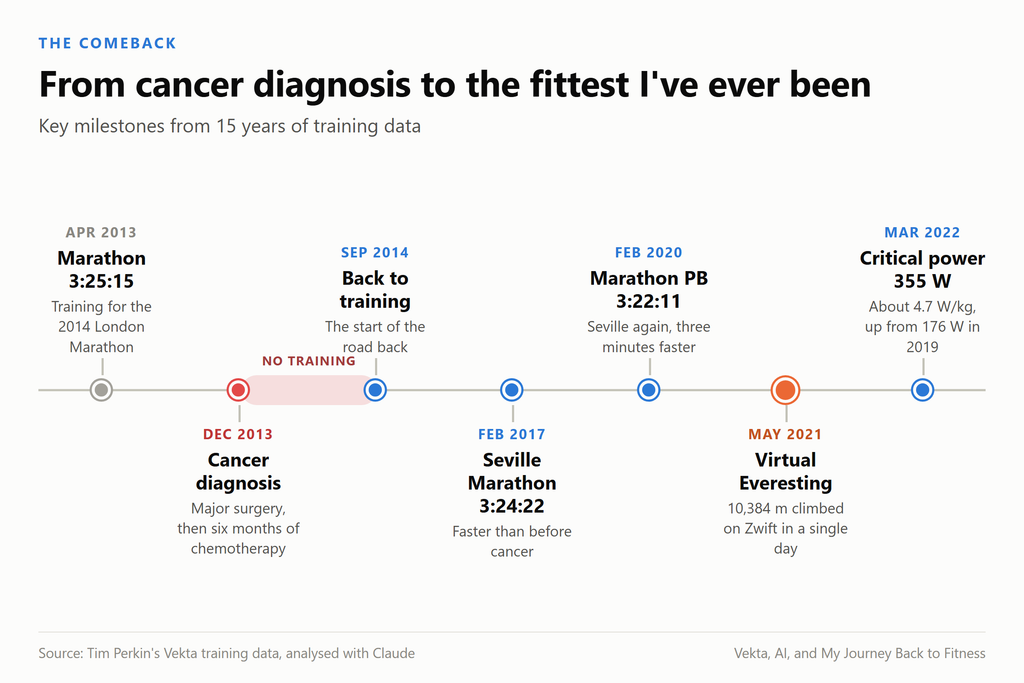
In 2013, at age 32, I was training for the 2014 London Marathon when I was unexpectedly diagnosed with cancer. What followed was major surgery and six months of chemotherapy. In September 2014, I began the arduous task of trying to regain my health and fitness. Until now, I have always wondered, “Am I fitter now than I was pre-cancer?”
It is a question I have never been able to adequately answer, but thanks to Vekta, I am now in a position to do so.
The Power of Vekta
Vekta is a training and coaching platform that uses advanced data analysis and AI technology to help athletes and coaches better understand performance and identify opportunities for improvement.
As a company, Vekta has witnessed unprecedented growth in the last year alone and is now working with several UCI WorldTour teams: Lidl-Trek, DECATHLON CMA CGM Team, and Team TotalEnergies. They join existing partners Team Jayco AlUla, Liv AlUla Jayco, FDJ United – SUEZ and Team AMANI.
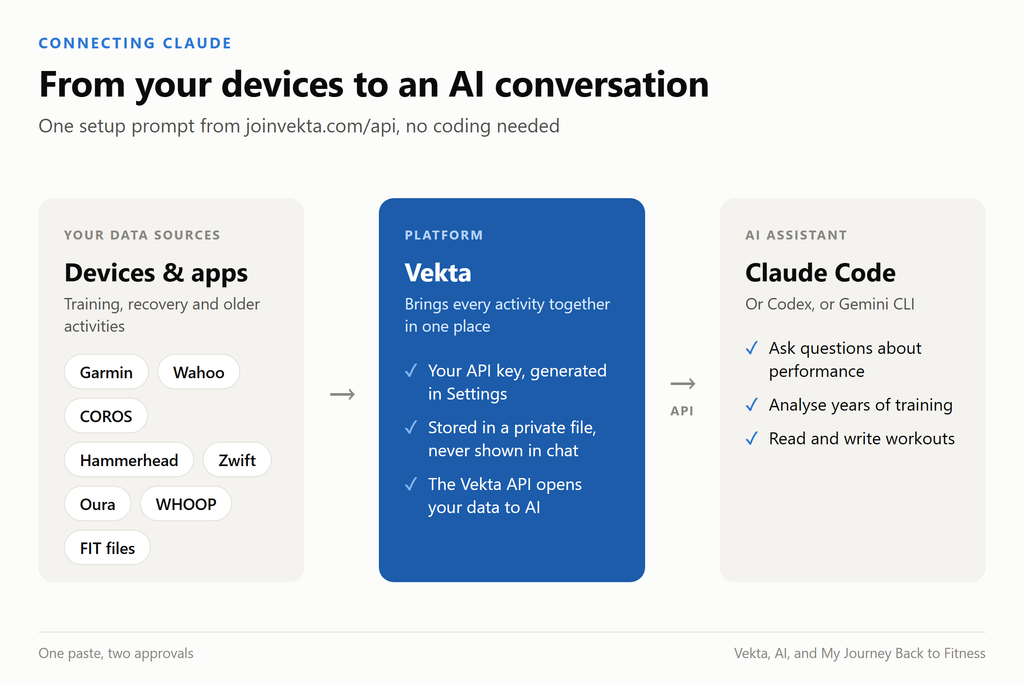
Vekta has built a modern AI-powered training and coaching platform that integrates with Garmin, Wahoo, COROS, Hammerhead and Zwift, as well as Oura and WHOOP for recovery data, and older activities can be imported as FIT files. It is designed to optimise performance for endurance athletes and support coaches with advanced insights.
Recently, Vekta launched its API, which connects to AI assistants such as Claude, Codex and Gemini. No coding is needed: a single setup prompt from joinvekta.com/api, pasted into your AI assistant, enables athletes and coaches alike to question performance data and gain incredible race insights, as well as looking broader and answering specific health and fitness queries, which was what I was going to use it for.
Connecting Claude
The first thing required was to connect Claude—in particular, Claude Code—to my Vekta data, utilising an Application Programming Interface (API). Think of Claude as the AI you have a conversation with, while Claude Code is its more technical counterpart, capable of interacting with files, software and data to undertake more complex tasks.
Connecting to my data wasn’t a difficult task, but you need an API key from Vekta, which you can now generate yourself in your Settings in Vekta. Once you have it, you copy the single setup prompt from joinvekta.com/api and paste it into Claude Code. As Claude explains:
“Connecting an AI assistant to your training data no longer takes code. One prompt lets Claude Code, Codex, or Gemini CLI link to the Vekta API and read and write your workouts in any future chat. Your API key never appears in the conversation. You paste it into a private file, and the assistant moves it somewhere only you can read. It then tests the connection by checking your name, how many athletes you coach, and your last week of activities. Last, it saves a note to its memory so every new chat knows how to use your data safely. All it takes is one paste and two approvals.”
The Importance of Data Quality
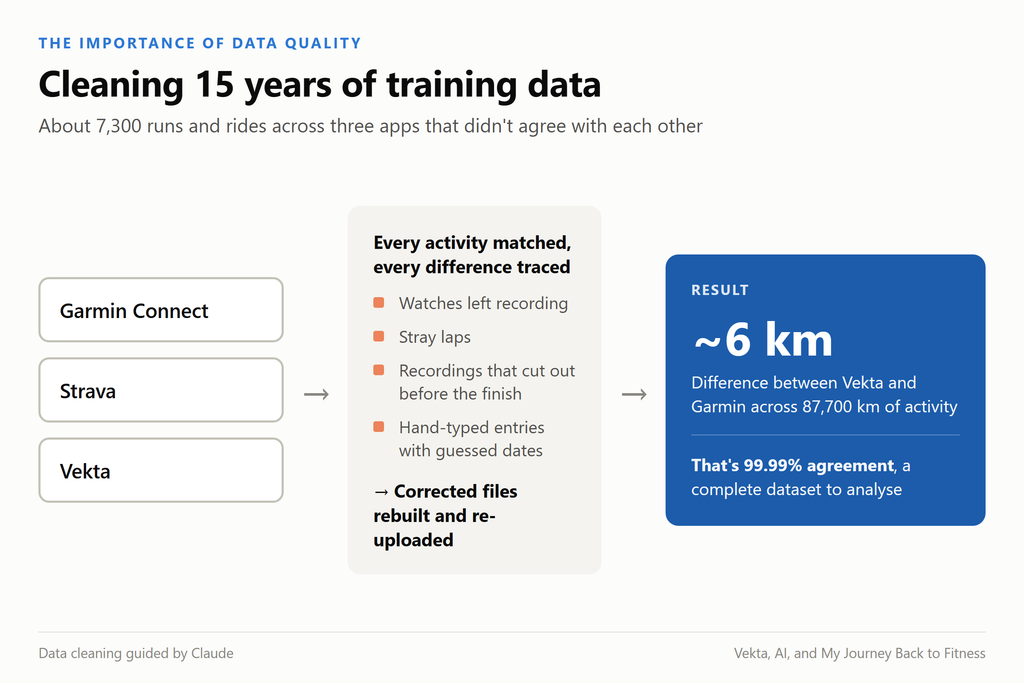
Before I could start interpreting my Vekta data using Claude, I had to do one important activity that turned out to be time-consuming but completely necessary: cleaning my data. For this activity, I was guided by Claude, who summarises the work undertaken:
“Tim’s 15 years of training, about 7,300 runs and rides, were spread across Garmin Connect, Strava, and Vekta, and the three didn’t agree. I matched every activity across the three apps and traced each difference to its cause: watches left recording, stray laps, recordings that cut out before the finish, and hand-typed entries with guessed dates. Then I rebuilt corrected files for him to upload. After several rounds of corrections and checks, the total recorded distance in Vekta matched Garmin to within approximately 6 km across 87,700 km of activity.”
The reason this was necessary was because without a complete dataset, the output would not be accurate.
The Importance of Prompting
The next challenge was learning how to ask the right questions. AI is only as useful as the information and instructions you give it. These instructions are known as prompts.
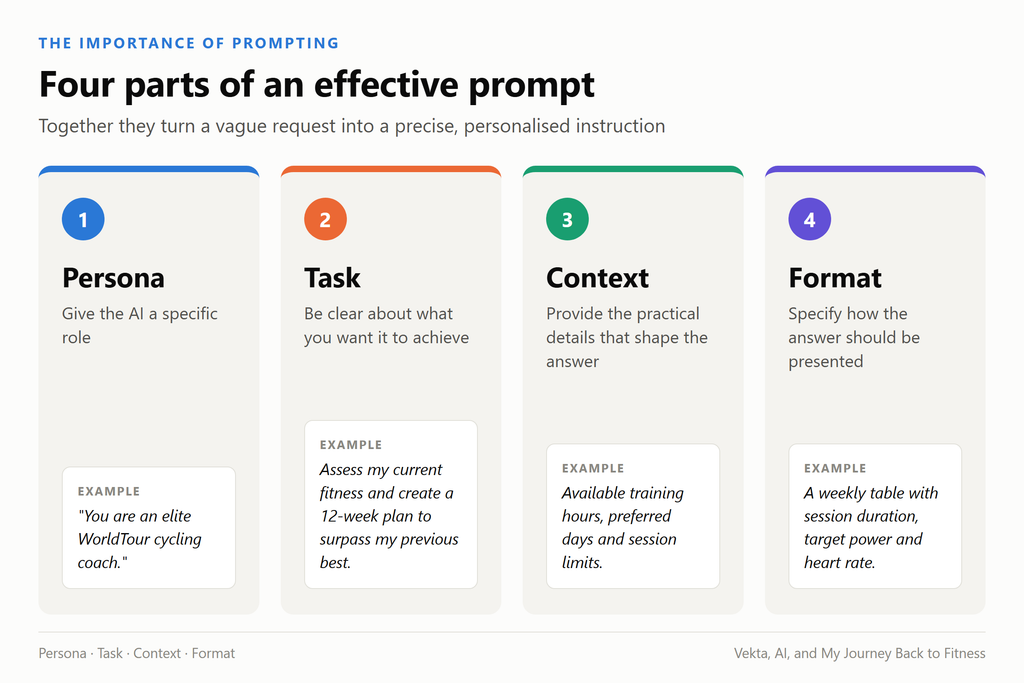
Through research, I learned that an effective prompt has four key components:
- Persona: Give the AI a specific role, such as “You are an elite WorldTour cycling coach.”
- Task: Be clear about what you want it to achieve, for example, assessing my current fitness and creating a 12-week plan to surpass my previous best.
- Context: Provide the practical details that shape the answer, including my available training hours, preferred days, and session limits.
- Format: Specify how you want the information presented, such as a weekly table detailing session duration, target power, and heart rate.
Using these four elements transformed vague requests into much more precise and personalised instructions.
The Definitive Prompt
As my prompting skills with AI need polishing, I asked AI to help write me a detailed prompt that Claude could use; it was extensive, so an abridged version is provided below:
Act as a WorldTour-level cycling performance coach and sports scientist with endurance-running experience, assessing my fitness objectively using Vekta data only.
I am Tim Perkin, a self-coached amateur athlete who was diagnosed with cancer in December 2013 and returned to training in September 2014. Compare my pre-diagnosis fitness with my performance after returning, identifying when I first regained my previous level, which measures recovered, and whether I am fitter today.
Analyze training volume, consistency, training load, speed, aerobic efficiency, durability, and cycling power where sufficient data exists, linking changes to the training behind them. Cover the period before December 11, 2013, including my best three-month spell, the activity gap from December 12, 2013, to August 31, 2014, without making fitness judgments, and my return from September 2014 to present, month by month.
Use recorded activities for performance measures, counting manually entered activities only towards training volume; exclude duplicates, empty watch fragments, and treat missing heart rates as unrecorded. Before undertaking the analysis, provide a short data audit showing usable runs and rides by period and months.
Produce an Excel workbook with a coach’s summary, monthly trends, charts, best efforts, and a complete activity log with Vekta links. Finish with a direct coaching debrief covering the verdict, recovery milestones, measures that never recovered, confidence in the findings, and two or three lessons for my current training. Do not modify, delete, or upload any data, invent missing metrics, or provide medical advice or speculation.
The Results
What Claude produced made for some fascinating reading.
Were you fitter after cancer? What the data says
You were diagnosed with cancer in December 2013 and started training again in September 2014. I went through 15 years of your training data in Vekta—more than 7,300 activities—to answer one question: did you ever get fitter than you were before? You did, first as a runner and then as a cyclist.
Running: back to your best, and a marathon personal best
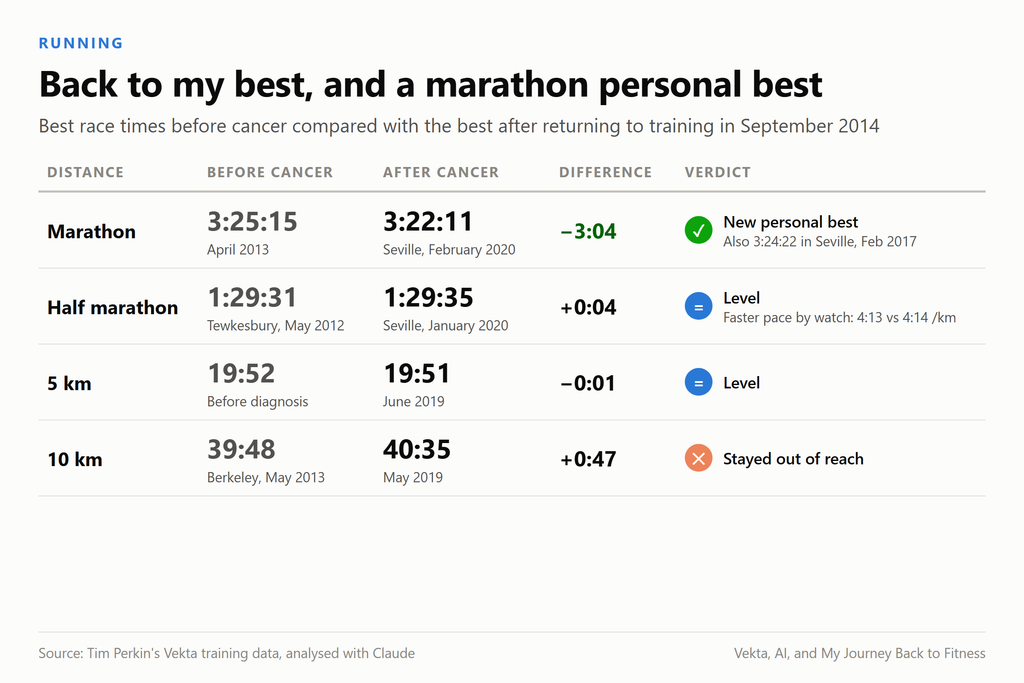
The comeback took time. Your running didn’t get back to its old volume until late 2016. Then the race times came back to where they had been, and in the marathon you went further:
- Marathon: 3:25:15 before cancer (April 2013). After cancer, you ran 3:24:22 in Seville in February 2017, then 3:22:11 in Seville in February 2020. That’s a personal best by three minutes.
- Half marathon: 1:29:31 at Tewkesbury in May 2012. After cancer, you ran 1:29:35 in Seville in January 2020. That’s 4 seconds slower on the clock. But your watch measured Seville at 21.23 km, against 21.13 km at Tewkesbury, so by your watch’s distance, your pace was faster: 4:13/km against 4:14/km.
- 5 km: level. 19:52 before, and 19:51 in June 2019.
- 10 km: the one that stayed out of reach. You ran 39:58 in February 2012 and 39:48 in May May 2013, and your best after cancer was 40:35 in May 2019.
How virtual cycling made you fit
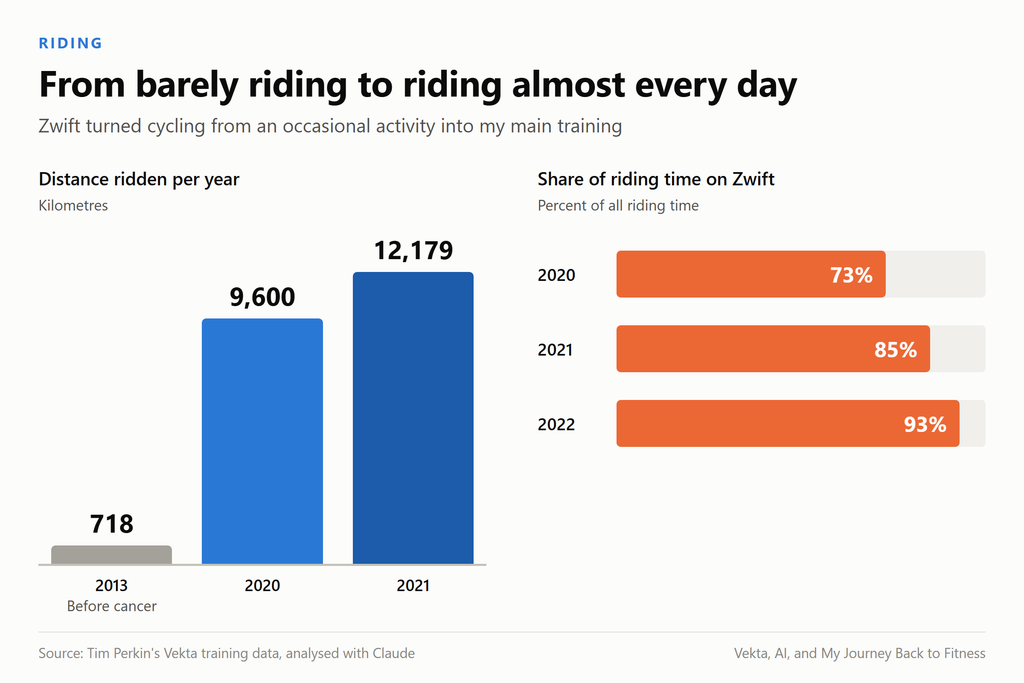
Before cancer, you barely rode: 718 km in 2013. From mid-2020, Zwift became your main training, and you rode 9,600 km that year and 12,179 km in 2021.
Your power shows the gains:
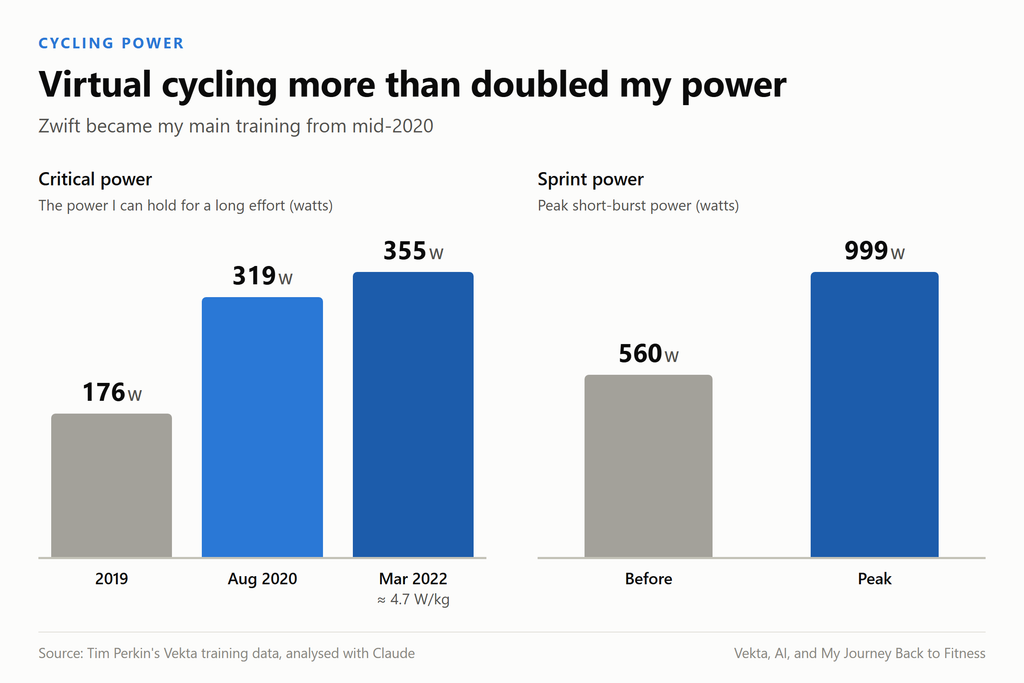
- Critical power (the power you can hold for a long effort) was 176 W in 2019. It reached 319 W by August 2020 and 355 W by March 2022, about 4.7 W/kg.
- Sprint power went from 560 W to 999 W.
Your heart rate tells the same story:
- On steady Zwift rides averaging 170–200 W, your heart rate averaged just 117–120 bpm through 2020 and 2021.
- You got more power from each heartbeat in 2020–21 than in any later year.
- On May 1 and 15, 2021, you rode nearly three hours each time, climbing more than 2,000 m at 165–175 W, with an average heart rate of only 102–108 bpm.
The virtual Everesting: May 29, 2021
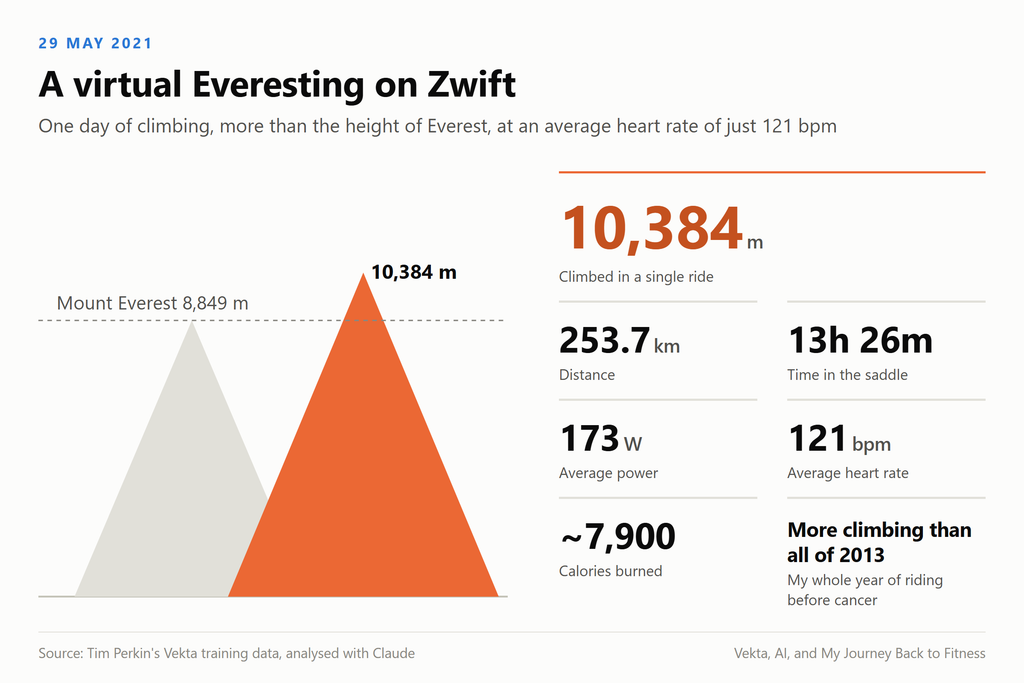
Those May rides were the build-up. On May 29, 2021, you completed a virtual Everesting on Zwift:
- Climbing: 10,384 m, more than the height of Everest.
- Distance and time: 253.7 km in 13 hours 26 minutes.
- Effort: 173 W average, and your heart rate averaged just 121 bpm.
- Calories: almost 7,900.
Before cancer, your whole year of riding in 2013 had less climbing than that one day.
Every ride counted: why Zwift mattered
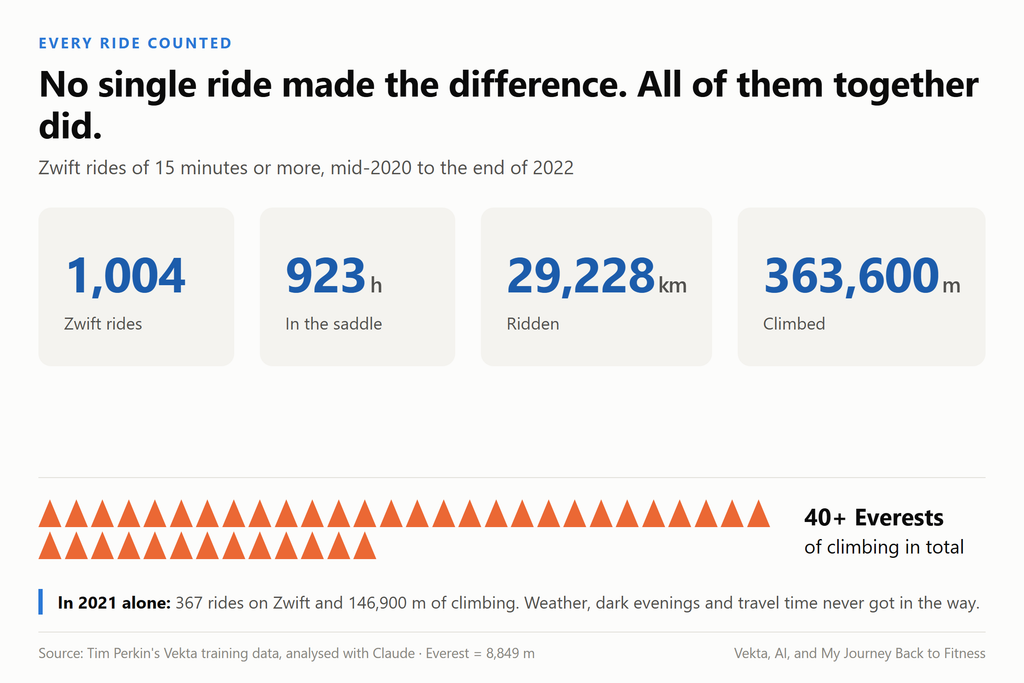
The gains on the bike didn’t come from a handful of big days. They came from riding on Zwift almost every day. Between mid-2020 and the end of 2022, you completed 1,004 Zwift rides of 15 minutes or more: 923 hours in the saddle, 29,228 km, and 363,600 m of climbing, the height of Everest more than 40 times over.
Zwift quickly became where your riding happened. It accounted for 73% of your riding time in 2020, 85% in 2021 and 93% in 2022. In 2021 alone, you rode 367 times on Zwift and climbed 146,900 m.
That consistency is what moved your numbers. Most of those rides were steady and unremarkable on their own, but together they built the aerobic engine behind a 355 W critical power and a 13-hour Everesting at an average heart rate of just 121 bpm. Riding indoors also meant that the weather, dark evenings and the time it takes to get out on the road never got in the way.
Zwift also recorded every one of those rides with power and heart rate. Without that record, there would be no critical power history to analyse, and the answer to whether you came back fitter would be far less certain.
The bike made you fast on foot
In 2021, you hardly ran: 181 km all year. Yet on August 16, 2021, you ran a set of about 700 m intervals. After two easier reps to warm up, you ran seven hard ones, getting faster each time, from 3:57/km down to 3:33/km. Your fastest rep covered 697 m in 2:29. That’s quicker than the pace of your best 10 km before cancer, and the fitness came almost entirely from the bike.
The verdict
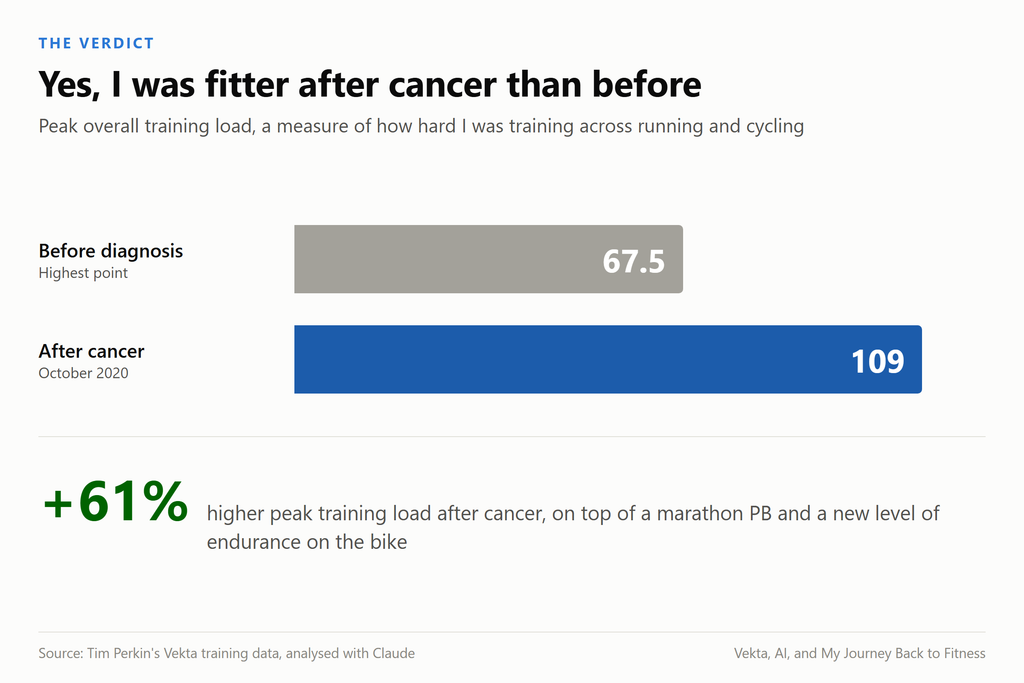
Yes, you were fitter after cancer than before. As a runner, you regained your previous performance levels and beat your marathon personal best by three minutes. On the bike, you developed an entirely new level of endurance fitness, reaching your peak between 2020 and 2022. Your overall training load, a measure of how hard you were training across both sports, peaked at 109 in October 2020, against 67.5 at its highest before diagnosis.
It didn’t happen quickly. It took several years of consistent training. But after cancer, you didn’t just come back. You went further.
Conclusion
For more than ten years, I’ve wondered whether I ever got back to the athlete I was before cancer. Now I have an answer, and it’s better than I hoped. I not only returned to my previous running performance, but went on to achieve a marathon personal best. On the bike, I became an athlete I had never been, climbing more than 10,000 metres in a single day.
The analysis also showed me something I hadn’t fully appreciated: how much of this I owe to Zwift and to the sheer number of rides. More than a thousand rides between 2020 and 2022, most of them ordinary sessions on a dark evening or an early morning, added up to the fittest I have ever been. No single ride made the difference. All of them together did.
Three things made that answer possible. First, Vekta brought fifteen years of training data together in one place. Second, taking the time to clean that data meant the analysis was based on reliable information rather than gaps and errors. Finally, learning how to prompt AI properly transformed a vague question into a detailed performance assessment.
The biggest lesson was that AI didn’t magically make me fitter, nor did it uncover something that wasn’t already in my data. It gave me the tools to understand what I’d achieved and how I got there.
There was no shortcut. It took years of consistent training to reach those levels again.
But I now have a new question: can I get back to my peak fitness? This time, rather than wondering, I have Vekta, Claude and fifteen years of training data to help me find out. Part 2 looks at the plan that I will utilize.