Garmin’s new CIRQA enters a growing market of screen-free health trackers dominated by WHOOP. Designed for users who want continuous health and recovery monitoring without wearing a smartwatch around the clock, it is Garmin’s answer to the subscription-based wearable model while remaining firmly integrated into the Garmin ecosystem.
Launched in July 2026 it is priced at $199.99 / £179.99 / €199.99 but unlike WHOOP there is no mandatory subscription for the core health, sleep and training features and it connects through the Garmin Connect app via Bluetooth.
It is important to understand that the CIRQA is designed to complement, rather than replace, a smartwatch. Its primary purpose is to provide continuous health and recovery monitoring for users who want to track their metrics 24/7 without wearing a traditional watch around the clock.
What it measures
The device is a health and fitness tracker that records the following metrics:
- Heart rate
- Heart Rate Variability (HRV)
- Sleep
- Stress
- Body Battery
- Training Readiness
- VO2 Max
- Calories
- Steps
- Activities and workouts
All this data is collected and displayed in the Garmin Connect app. You can wear the CIRQA continuously while using a Garmin watch when you need a screen, GPS and more advanced workout information.
It does not measure ECG and it broadcasts on standard ANT+ and Bluetooth.
What’s in the Box
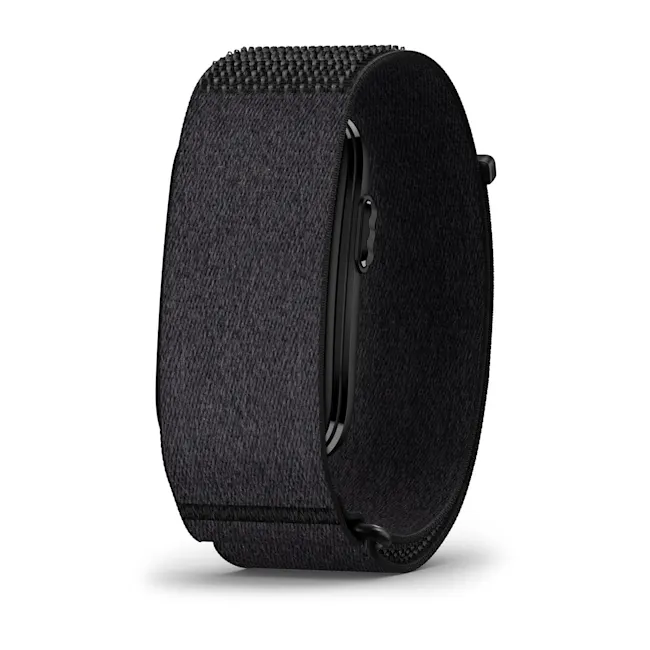
Garmin keeps the CIRQA package simple and provides everything you need to get started straight away. Inside the box, you’ll find the CIRQA sensor pre-attached to the wrist strap. I opted for the black version, so it could be used universally. Also included is the charging cable, which connects to Garmin’s standard charging port on the sensor device, as well as a set of quick-start instructions to guide you through the initial setup, pairing, and operation.
Design and fit
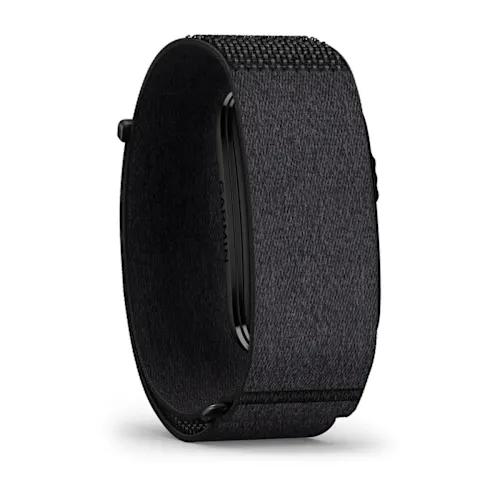
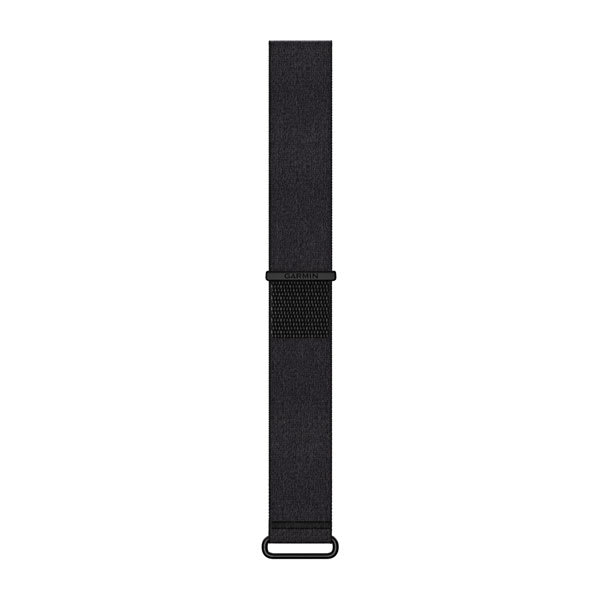
The CIRQA is a compact sensor device that is connected to a fabric band that has Velcro. It is lightweight and weighs only 15 grams, with the Velcro it totals 20 grams. It is comfortable as it is designed to be worn overnight. There is no screen and it smaller than most watches. While this is not intended to be a direct comparison with WHOOP, it is worth noting that the CIRQA is narrower but slightly longer, which may be noticeable on smaller wrists.
This review is not going to compare it to its competitor, WHOOP but I do want to point out that it is narrower in width but slightly longer in length, so may not be ideal if you have a narrow wrist, however, it’s not noticeable.
It measures 27 x 47 x 9 mm and there are two sizes for the wrist strap:
- S/M: 24.5 x 2.4 x 0.2 cm (9.6 x 9.5 x 0.08 in.)
- L/XL: 28.5 x 2.4 x 0.2 cm (11.2 x 9.5 x 0.08 in.)
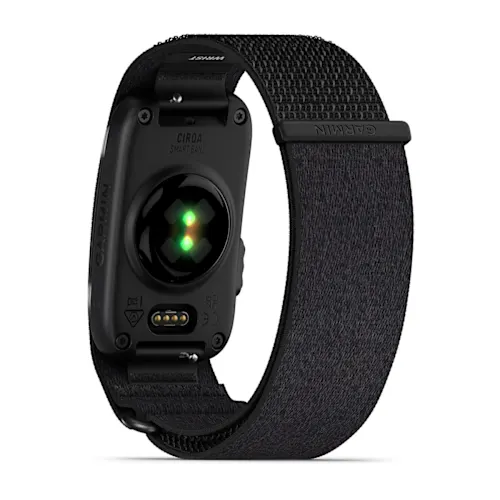
If you are more comfortable with wearing such a device on your upper arm, there is an accessory armband that can be purchased and you can fit the sensor to that. The strap can be changed by pulling on two pins that release the clips from the sensor. This may be tricky if you have large fingers, it certainly was the case for me.
Garmin has incorporated a physical control button. The button can be used to start, pause, or stop workouts without reaching for your phone. You can use the button to broadcast heart rate data.
The Optical Heart Rate Monitor is at the back of the sensor and utilises Garmin’s Gen 4 sensor, as opposed to their newest Gen 5. Located next to the sensor is Garmin’s standard charging port.
CIRQA’s lightweight and comfortable design, flexible wearing options, practical physical controls, and reliable Garmin heart-rate technology make it a discreet and minimalist fitness tracker.
Colours
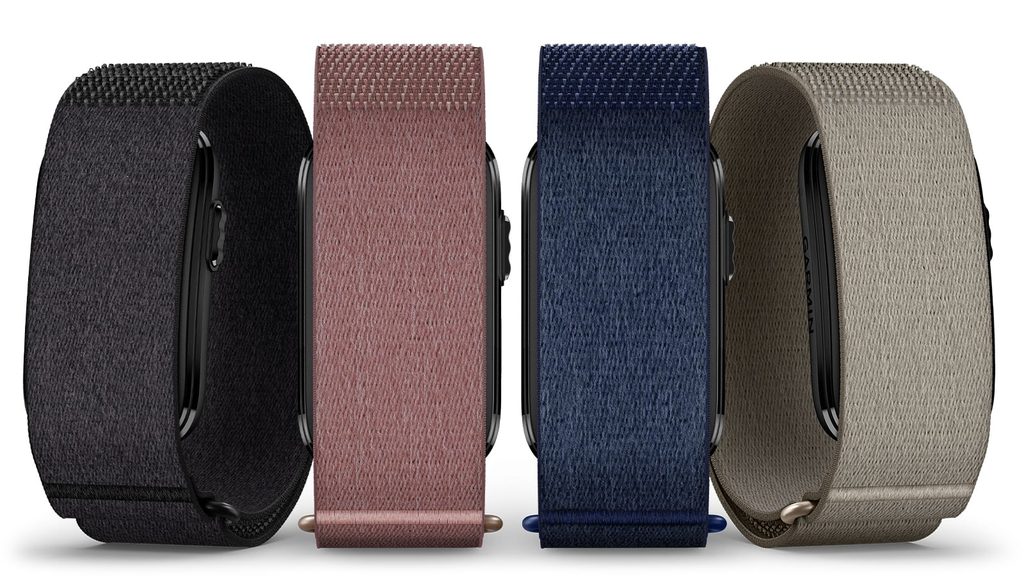
There are four standard band colours available:
- Black
- Captain Blue
- Mauve
- French Gray
In addition, three accessory band colours are available for purchase:
- Citron Gray
- Dark Olive
- French Blue
This enables you to match the band with a particular outfit, should you wish, ensuring the device is a discreet matching accessory and not a talking point.
Battery life
Battery life is one of the CIRQA’s strengths. Garmin quotes up to 10 days of battery life, although in my testing I generally topped it up before reaching that point. Battery status is displayed clearly within the Garmin Connect app, making it easy to keep an eye on the remaining charge.
What I did notice, however, was that battery consumption increased noticeably when broadcasting heart-rate data to indoor training platforms such as Zwift. This isn’t unexpected given the additional wireless activity, but it is worth bearing in mind if you regularly use the CIRQA as a heart-rate sensor for indoor cycling or other connected workouts. For most users, battery life is unlikely to be a concern, but those who frequently use the heart-rate broadcasting feature should expect to charge it more often than Garmin’s headline figure might suggest.
No GPS and other Garmin devices
The CIRQA doesn’t contain a GPS, and it is not intended to replace your running watch or cycling computer. It works with Garmin Connect app as a Connected GPS and integrates seamlessly with your other Garmin devices.
When cycling, the CIRQA comes into its own because if you are using a Garmin Edge, the CIRQA pairs to it without an issue. The Garmin Edge looks after your ride data, whilst the CIRQA looks after your health metrics, which all eventually get uploaded to Garmin Connect. In many situations, the CIRQA can eliminate the need for a traditional heart-rate chest strap. If you’re already recording your activities on a Garmin Edge, you can also leave your smartwatch at home and simply wear the lighter, more comfortable CIRQA.
Key features explored
Heart-rate accuracy
This is probably the most important area to consider.
I tested this by connecting the CIRQA to Zwift whilst simultaneously using my Garmin Venu 4 to compare the data. CIRQA is my new go-to for heart rate monitoring when cycling indoors, replacing my heartrate chest strap because it’s more comfortable.
The heart-rate accuracy was very good during cycling with results often closely matching, within a few beats of the reference device.
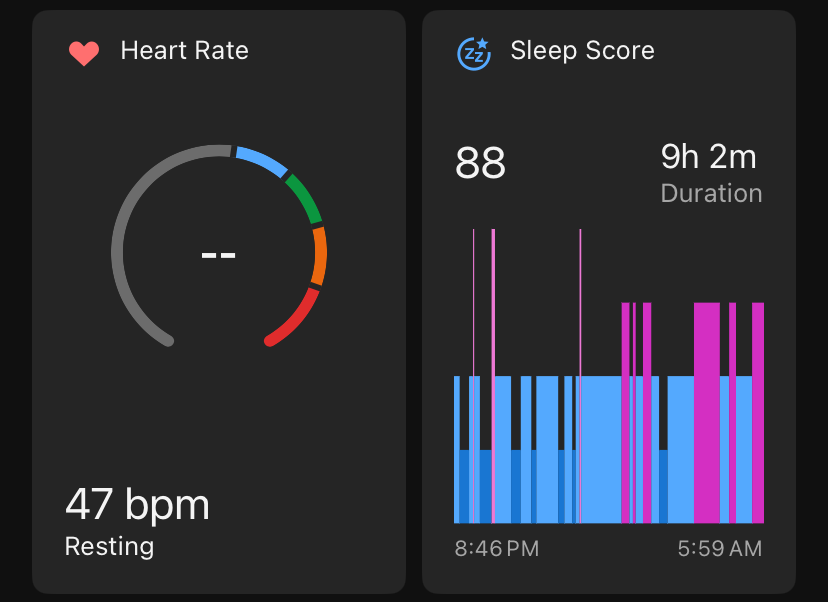
I noticed that the heart rate field in Garmin Connect was not displaying any data and remained blank. While the app could detect heart rate information from my Venu 4 watch, it did not appear to switch automatically to the CIRQA sensor when the watch was not being worn, as I would have expected. I spent some time troubleshooting the issue but was unable to get it working correctly.
Sleep
Wearing the CIRQA overnight is comfortable and, thanks to its lightweight design, it’s easy to forget it’s there. However, sleep tracking was the area where I had the least confidence in the data. On several occasions the device reported lengthy periods of high-quality sleep despite my recollection of being awake during the night and waking up feeling far from refreshed the following morning. This wasn’t an isolated occurrence, which left me questioning how accurately the CIRQA was interpreting periods of inactivity and sleep.
Smart alarm
There are two alarms, one that you can fix a time to, using the Garmin Connect app and a smart alarm, which is designed to wake you up gently at the optimal time based on your sleep. I set the alarm and the vibration on your wrist is certainly more pleasant than the beeping sound of an alarm, so this is a nice feature. The alarm can be set once, daily weekday or weekend.
While the alarm worked reliably during my testing, some users on Garmin’s forums have reported occasional issues with alarm functionality. I didn’t encounter these problems personally, but it is worth keeping an eye on as the product matures.
Steps
I noticed that step tracking wasn’t always perfectly consistent. Most days the numbers looked reasonable, but there were occasions when the step count seemed a little light considering the amount of walking and general movement I’d done. It never felt wildly inaccurate, but enough to catch my attention when comparing it against my normal daily activity. For most users this likely won’t be a dealbreaker, but those who pay close attention to step-based goals may notice the occasional missed steps or lower-than-expected totals.
Pros and Cons
Pros
- No mandatory subscription
- Comfortable enough for 24/7 wear
- Excellent integration with Garmin Connect
- Accurate heart-rate monitoring during cycling
- Works seamlessly with Garmin Edge devices
- Ten-day battery life
Cons
- Sleep tracking can be inconsistent
- Occasional step-count discrepancies
- Heart-rate display issue within Garmin Connect
- Uses Garmin’s older Gen 4 sensor
- No ECG functionality
Summing up
After several weeks of testing, the Garmin CIRQA has proven itself to be a compelling addition to the Garmin ecosystem. It fills a niche that many Garmin users have been asking for: a lightweight, screen-free device that provides continuous health and recovery tracking without requiring you to wear a smartwatch 24 hours a day.
Where the CIRQA excels is its comfort, simplicity, and integration with Garmin Connect. The lightweight design makes it easy to forget you’re wearing it, particularly overnight, and the heart-rate performance was impressive during cycling and indoor training. For cyclists already using a Garmin Edge, or runners and athletes who don’t want to wear a watch all day, the CIRQA offers a practical alternative while still capturing the health metrics that matter most.
That said, it is not without its shortcomings. Sleep tracking occasionally produced results that didn’t align with how I actually felt, step counting was sometimes a little conservative, and I experienced an issue where Garmin Connect would not display heart-rate data from the CIRQA when my Venu 4 was not being worn. None of these issues were significant enough to stop me using it, but they do highlight that the platform still has room for refinement.
The biggest advantage over competitors is the lack of a mandatory subscription. Once you’ve purchased the device, all of Garmin’s core health, wellness, and training metrics are available without additional monthly fees. For users already invested in Garmin’s ecosystem, this alone makes the CIRQA an attractive proposition.
Overall, the Garmin CIRQA is not designed to replace your smartwatch, cycling computer, or GPS watch. Instead, it complements them by providing comfortable, around-the-clock health monitoring in a discreet form factor. Despite a few quirks and occasional data inconsistencies, I found myself reaching for it more often than expected, particularly for indoor cycling and overnight wear. If you’re already a Garmin user looking for a dedicated health and recovery tracker, the CIRQA is well worth considering and is likely to become an increasingly capable device as Garmin continues to refine the software experience.
After using the CIRQA for several weeks, the question becomes simple: would I buy one with my own money? Absolutely. Despite a few software quirks that will likely be addressed through future firmware updates, the combination of comfort, strong heart-rate performance, impressive battery life, and seamless Garmin integration means the CIRQA has earned a permanent place in my training toolkit. Whether I’m riding indoors on Zwift, tracking recovery overnight, or simply monitoring my daily health metrics, the CIRQA delivers a level of convenience that makes it easy to recommend to existing Garmin users.