Having established that I was fitter after cancer than before it, the next question was obvious: could I get back to my previous peak? This time, I wanted to take the experiment further. Could AI use 15 years of my cycling history to understand where I am today and build a realistic training programme to help me get back to my best?
My strongest cycling years came between 2020 and 2022. I was riding my biggest distances, producing my best power figures and, in May 2021, completing a virtual Everesting. That was several years ago. Having the historical data is one thing; knowing what to do with it is another. I wanted to find out whether AI could turn that history into a practical plan for the rider I am now.
Rather than follow a generic plan, I started where a good coach would: with the data. I asked Claude to analyse my Vekta history and build an eight-week Zwift programme aimed at moving me back towards my previous peak fitness.
The Process
To give Claude enough information to produce a useful plan, I set out my available training time and how much structured work I was prepared to do. In the past, I had completed session after session of structured training on a smart trainer using ERG mode, where the trainer controls resistance. Over time, that approach became monotonous. I therefore asked for no more than three structured sessions a week, with the remaining riding designed around them.
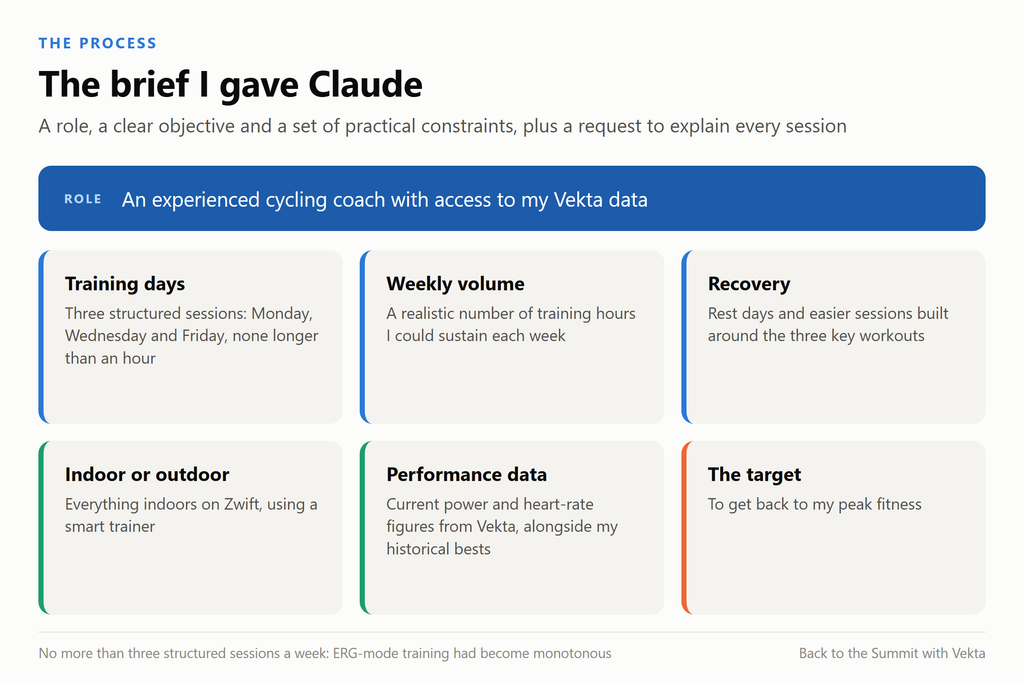
Rather than simply asking Claude a series of questions, I gave it a role: to act as an experienced cycling coach with access to my Vekta data. The task was no longer just to analyse my past; it was to use that information to make recommendations about my future training. I gave it a clear objective and a set of practical constraints:
- Training days: three structured sessions on Monday, Wednesday and Friday, none longer than an hour.
- Weekly volume: a realistic number of training hours that I could sustain each week.
- Recovery: rest days and easier sessions built around the three key workouts.
- Indoor or outdoor: everything indoors on Zwift, using a smart trainer.
- Performance data: my current power and heart-rate figures from Vekta, alongside my historical bests.
- The target: to get back to my peak fitness.
I also asked Claude to identify my weaknesses and explain why it had selected each session. I wanted to understand the thinking behind the programme, not just receive a spreadsheet full of numbers.
AI Building the Plan
The following section summarises how Claude interpreted my Vekta data and used it to build an eight-week Zwift programme. It also explains the purpose of the sessions it recommended.
Starting with the Numbers
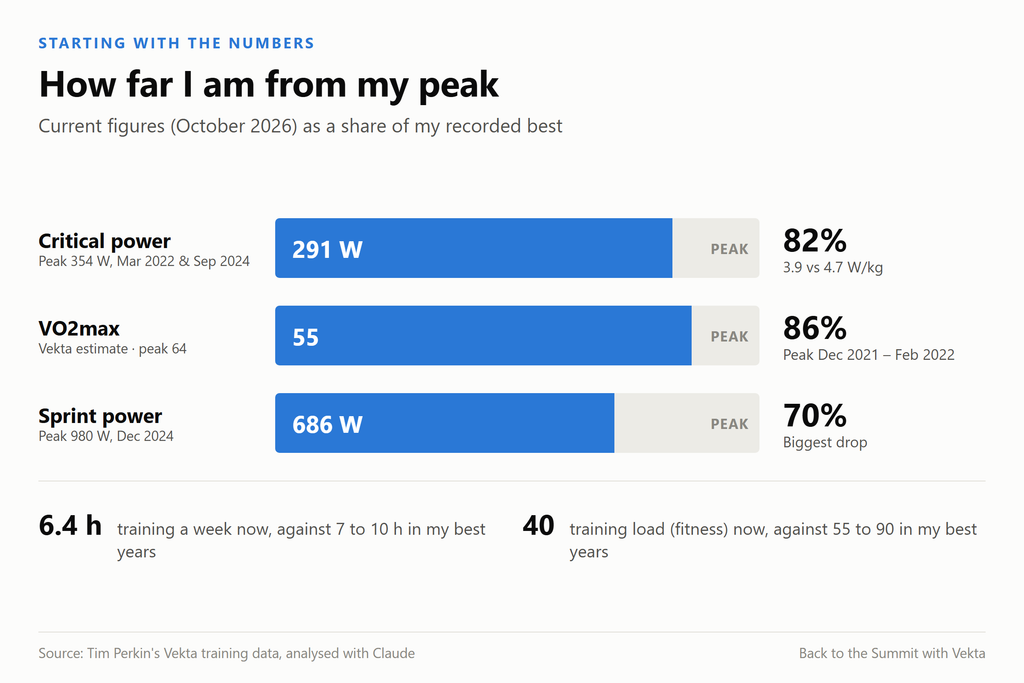
I reviewed your cycling history in Vekta, including critical power, W′ (your anaerobic reserve), Vekta’s estimated VO2max and maximum sprint power, alongside your logged rides. Here is how your current figures compare with your recorded bests:
| Measure | Now (Oct 2026) | Your peak | When |
| Critical power | 291 W (3.9 W/kg) | 354 W (4.7 W/kg) | Mar 2022 and Sep 2024 |
| VO2max (Vekta estimate) | 55 | 64 | Dec 2021 – Feb 2022 |
| Sprint (max) power | 686 W | 980 W | Dec 2024 |
| Training hours per week | 6.4 | 7 to 10 | Your best years |
| Training load (fitness) | 40 | 55 to 90 | Your best years |
What your history told me
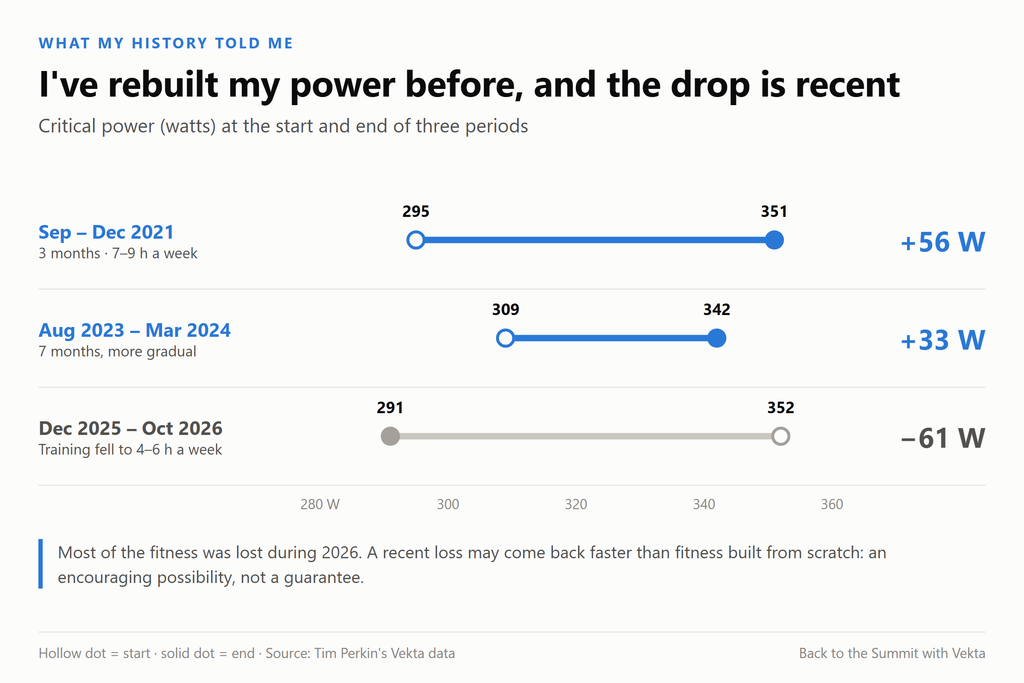
The most important finding was not simply how much fitness I had lost, but when I had lost it. My critical power was still 352 W in December 2025; most of the decline had occurred during 2026, as my training reduced to around four to six hours a week. Claude’s interpretation was that a relatively recent loss of fitness may be more quickly regained than fitness built from scratch. That is an encouraging possibility, not a guarantee.
My history also showed how I had responded to training in the past. Between September and December 2021, my critical power rose from 295 W to 351 W in three months while I was training for seven to nine hours a week. Between August 2023 and March 2024, it rose more gradually, from 309 W to 342 W over seven months. Claude used those two periods to help set expectations for this programme.
How the Plan Is Designed
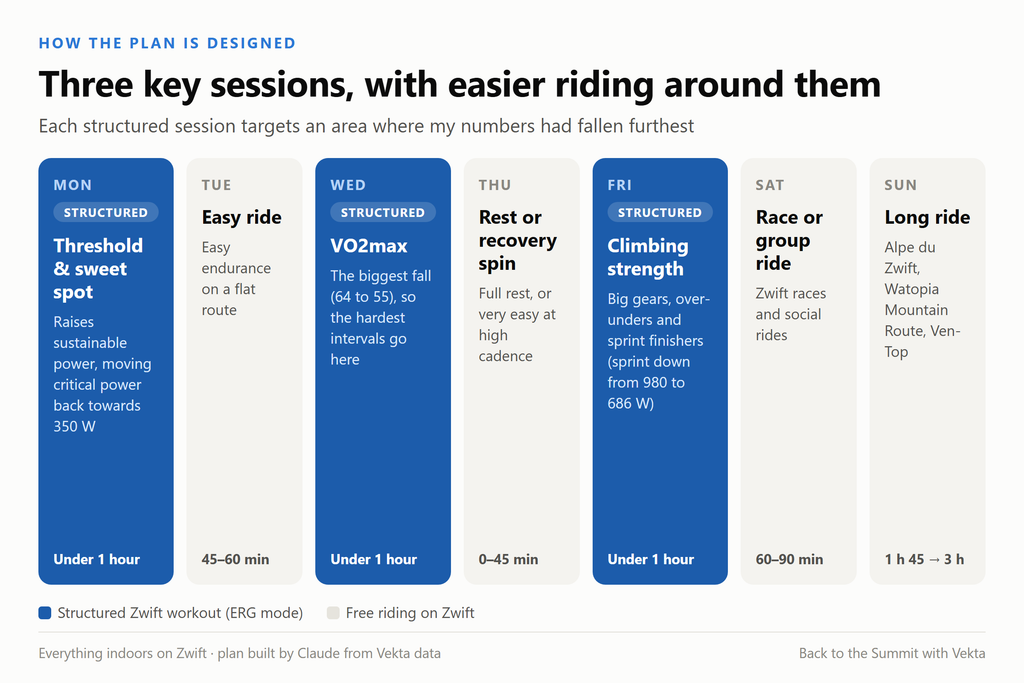
I asked for three structured Zwift sessions each week, on Monday, Wednesday and Friday, with each lasting no more than an hour. Claude gave each session a specific purpose, based on the areas where my numbers had fallen furthest:
- Monday – threshold and sweet spot: These sessions raise the power you can sustain, which is what moves your critical power back towards 350 W.
- Wednesday – VO2max: Your VO2max estimate has fallen the most (64 to 55), so the hardest interval work goes here.
- Friday – climbing strength: Big-gear strength, tempo with surges, over-unders, and a race simulation. Your sprint has dropped from 980 W to 686 W, so three Fridays end with a 10-second sprint finisher.
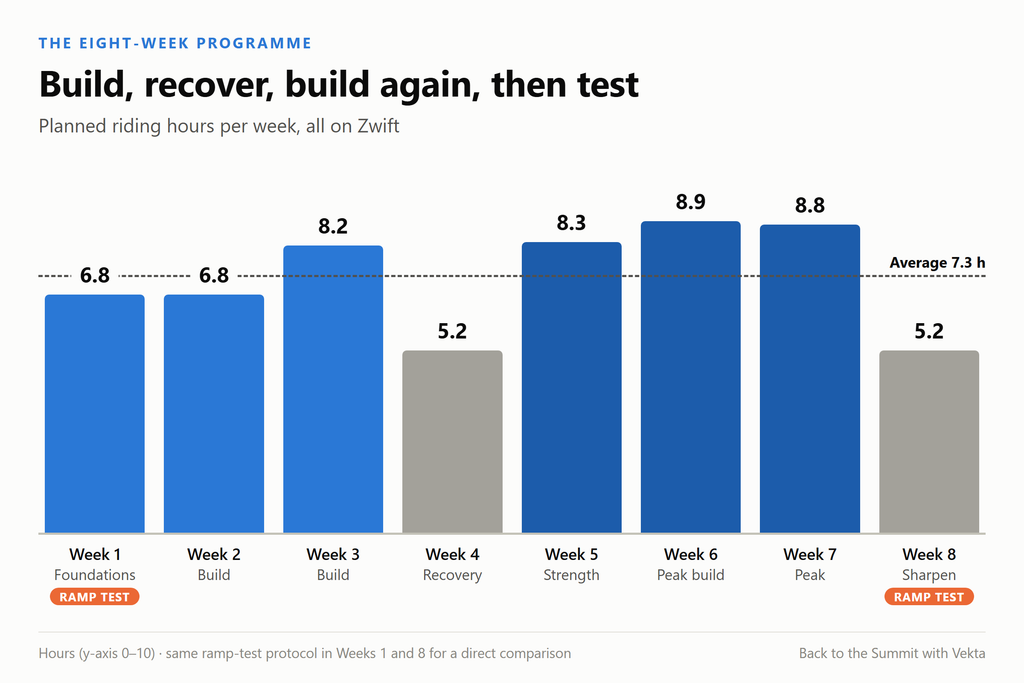
The eight weeks follow a familiar training structure: three weeks of building, a lighter recovery week, three further weeks of progressive work, and a final sharpening week that ends with a test. The plan begins and ends with the same ramp-test protocol, giving me a direct comparison. My starting Zwift FTP is 280 W, slightly below my 291 W critical power. FTP is the setting used to calculate the workout targets in Zwift; the opening test will help confirm or adjust that working figure.
Three hours of structured training alone are unlikely to take me back to 350 W. At my best, I was riding seven to ten hours a week, so the plan adds easier volume around the key sessions. Everything is indoors on Zwift: an easy ride on Tuesday, rest or a recovery spin on Thursday, a race or group ride on Saturday, and a longer ride on Sunday. The Sunday ride builds from 1 hour 45 minutes to three hours, using routes such as Alpe du Zwift, the Watopia Mountain Route and Ven-Top. The planned weekly total rises from about 6.8 hours to almost nine.
Each structured session is supplied as a Zwift workout file and is designed to be ridden in ERG mode. The trainer adjusts resistance towards the prescribed power target, while the workout targets are expressed as a percentage of FTP. That means the same files can scale to riders with different FTP values, including anyone taking part in a Mountain Massif club session.
The plan is based primarily on power rather than heart rate. In ERG mode, the trainer adjusts resistance to help me maintain each prescribed power target. Heart rate can vary with heat, fatigue and factors such as caffeine, so I will still record it on every ride and use Vekta to monitor how my body responds to the training.
| Week | Monday | Tuesday | Wednesday | Thursday | Friday | Saturday | Sunday | Hours |
| Week 1 Foundations | Base Camp Ramp Test Fitness test, 39 min Ramp test: steps from 140 W, +17 W a minute | Zwift easy ride, 60 min Easy endurance, 168-202 W, flat route such as Tempus Fugit | Foothills Openers VO2max introduction, 58 min 120% = 336 W | Rest day Full rest – recovery is training too | Valley Tempo Tempo, 57 min Endurance about 182-196 W | Zwift group ride (endurance pace), 90 min A social or C-category group ride – keep it chatty | Long ride on a Zwift route, 105 min Endurance 168-202 W, e.g. Watopia Big Loop | 6.8 |
| Week 2 Build | Sweet Spot Switchbacks Sweet spot, 58 min 89% = 249 W | Zwift easy ride, 60 min Easy endurance, 168-202 W, flat route such as Tempus Fugit | Hairpin Bends VO2max, 51 min 108% = 302 W, 110% = 308 W | Rest day Full rest – recovery is training too | Big Gear Grind Muscular endurance, 60 min 85% = 238 W, 200% = 560 W | Zwift race (short, flat), 60 min Race of 30-45 min plus warm-up – learn to follow wheels again | Long ride on a Zwift route, 120 min Endurance 168-202 W, with one long climb at steady tempo | 6.8 |
| Week 3 Build | Col de Sweet Spot Sweet spot, 55 min 90% = 252 W | Zwift easy ride, 60 min Easy endurance, 168-202 W, flat route such as Tempus Fugit | Steep Ramps VO2max, 51 min 110% = 308 W, 115% = 322 W | Zwift recovery spin, 45 min Very easy, under 154 W, high cadence | Over-Unders on the Massif Threshold over-unders, 56 min 95% = 266 W, 105% = 294 W, 200% = 560 W | Zwift race (rolling), 75 min Race of 45-60 min plus warm-up – practise positioning | Long ride: Alpe du Zwift, 150 min Endurance 168-202 W; climb the Alpe at 238-252 W | 8.2 |
| Week 4 Recovery | Rest Day Rolls Recovery, 38 min Endurance about 182-196 W | Zwift easy ride, 45 min Easy endurance, 168-202 W, flat route such as Tempus Fugit | Easy Openers Recovery, 48 min 130% = 364 W | Rest day Full rest – recovery is training too | Endurance Cruise Endurance, 60 min Endurance about 182-196 W | Zwift easy ride, 60 min Easy endurance, 168-202 W – recovery week | Zwift easy ride, 60 min Easy endurance, 168-202 W – recovery week | 5.2 |
| Week 5 Strength | Threshold Traverse Threshold, 55 min 97% = 272 W | Zwift easy ride, 60 min Easy endurance, 168-202 W, flat route such as Tempus Fugit | Summit Surges VO2max, 53 min 110% = 308 W, 118% = 330 W | Zwift recovery spin, 45 min Very easy, under 154 W, high cadence | Tempo with Kicks Tempo with surges, 58 min 85% = 238 W, 150% = 420 W | Zwift race (hilly), 75 min Race with a climb, e.g. Innsbruck or Watopia Hilly | Long ride on a Zwift route video, 150 min Endurance 168-202 W, a route of your choice | 8.3 |
| Week 6 Peak build | Threshold Climb Threshold, 60 min 95% = 266 W | Zwift easy ride, 60 min Easy endurance, 168-202 W, flat route such as Tempus Fugit | Micro Bursts 40-20 VO2max, 55 min 130% = 364 W | Zwift recovery spin, 45 min Very easy, under 154 W, high cadence | Over-Under Ridge Threshold over-unders, 57 min 95% = 266 W, 108% = 302 W, 200% = 560 W | Zwift race (mountain finish), 90 min Race with a summit finish, e.g. a Mountain Route or Alpe event | Long ride: Mountain Route, 165 min Watopia Mountain Route, steady climbing at 224-246 W | 8.9 |
| Week 7 Peak | The Long Climb Sweet spot to threshold, 52 min 88% = 246 W, 92% = 258 W, 96% = 269 W | Zwift easy ride, 60 min Easy endurance, 168-202 W, flat route such as Tempus Fugit | VO2 Ladder VO2max, 49 min 110% = 308 W, 112% = 314 W, 115% = 322 W, 120% = 336 W | Zwift recovery spin, 45 min Very easy, under 154 W, high cadence | Mountain Race Simulation Race simulation, 55 min 85% = 238 W, 88% = 246 W, 93% = 260 W, 95% = 266 W, 120% = 336 W, 140% = 392 W, 150% = 420 W, 180% = 504 W | Zwift race (your choice), 90 min Put your peak fitness to work | Long ride: Ven-Top or Epic KOM, 180 min Endurance 168-202 W with a long steady climb | 8.8 |
| Week 8 Sharpen and test | Sharpen the Edge Sweet spot and openers, 49 min 90% = 252 W, 120% = 336 W | Zwift easy ride, 45 min Easy endurance, 168-202 W, flat route such as Tempus Fugit | Pre-Summit Openers Openers, 45 min 105% = 294 W, 150% = 420 W | Rest day Full rest – recovery is training too | Summit Ramp Test Fitness test, 39 min Ramp test: steps from 140 W, +17 W a minute | Zwift easy ride, 45 min Easy – legs up after the Summit Ramp Test | Mountain Massif celebration ride, 90 min Easy social ride – celebrate your new FTP! | 5.2 |
| Average hours per week | 7.3 | |||||||
What AI has said I can expect
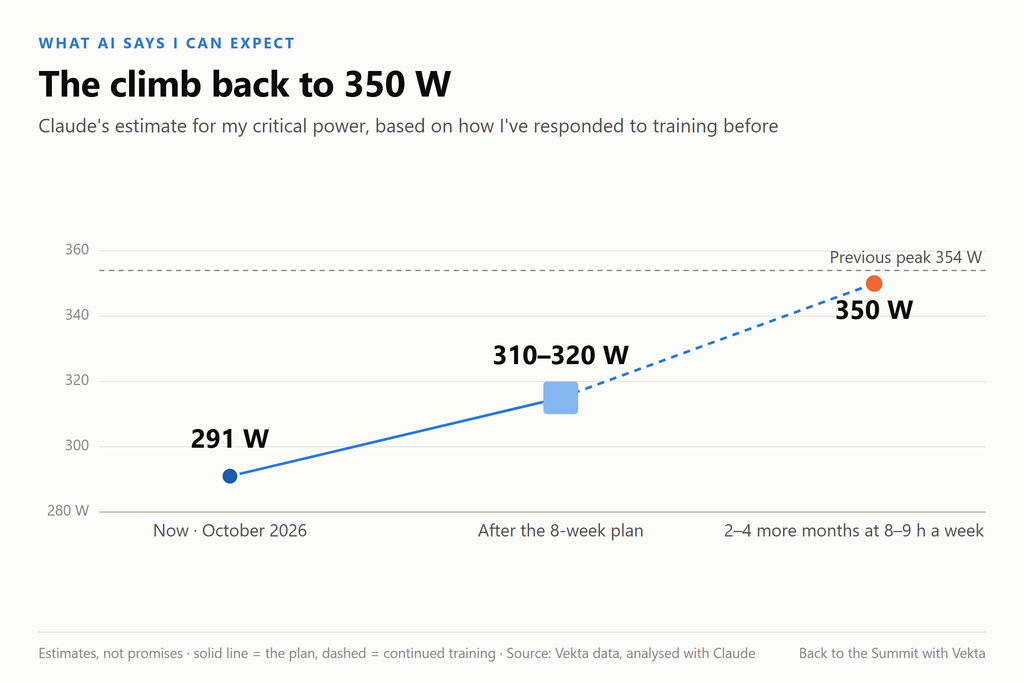
Claude’s assessment of what I might achieve was as follows:
“Based on how you have responded before, eight weeks of this plan should lift your critical power to around 310 to 320 W. Getting all the way back to 350 W will take longer: if you keep training 8 to 9 hours a week, your history suggests another two to four months after the plan ends. Vekta updates your critical power, VO2max estimate, and training load after every ride, so you can watch the climb as it happens.
The lesson Claude drew from my history was similar to the one that shaped my return to cycling after cancer: there are no shortcuts. Consistent training, a gradual increase in workload and proper recovery helped me reach my previous level. The programme is built around those same principles.
Next Steps
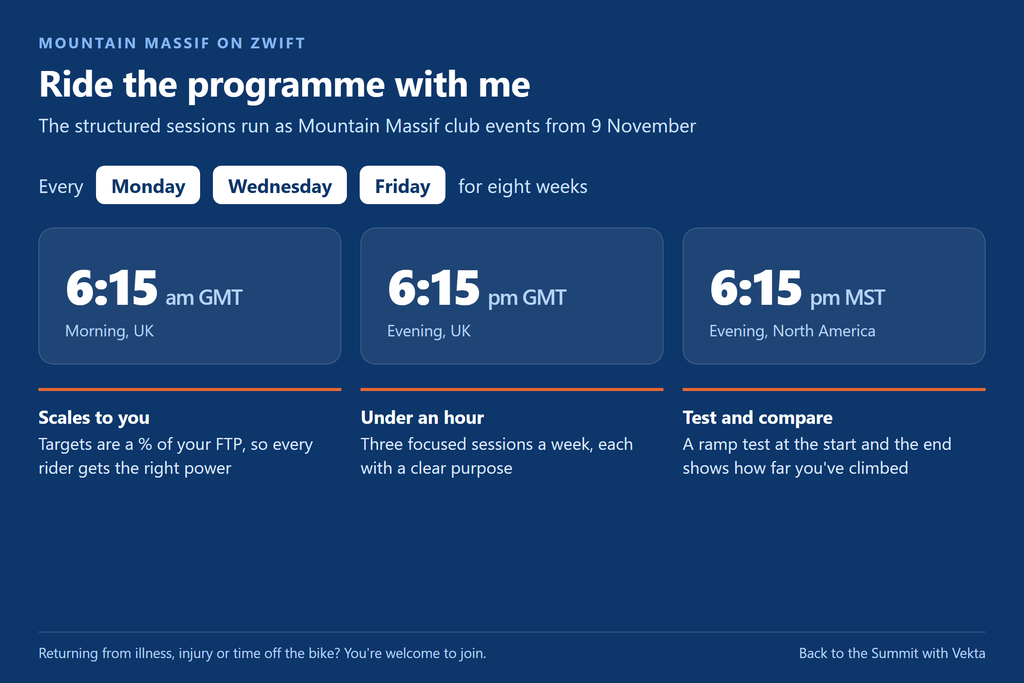
The next step was to ask Claude to turn the plan into 24 structured workouts that I could upload to Zwift. Using Zwift to deliver the sessions and Vekta to track my response, I am also making the workouts available through Mountain Massif events on Monday, Wednesday and Friday, starting 9 November. The three advertised start times are 6:15 am GMT, 6:15 pm GMT and 6:15 pm MST. To join up, visit here and select the time you want to train.
Turning the Plan into Zwift Workouts
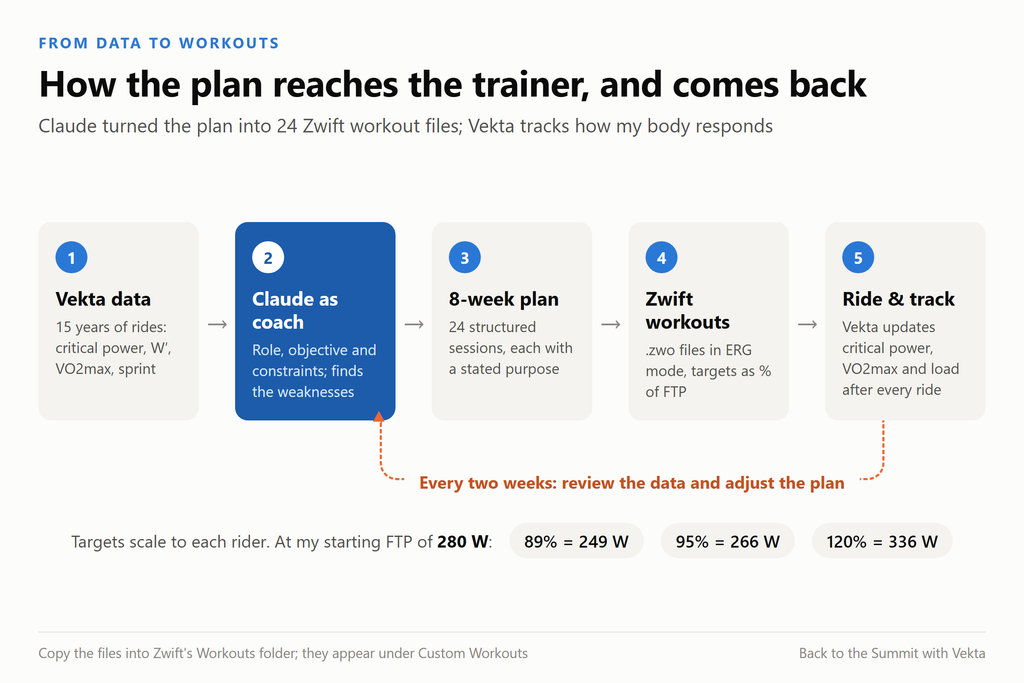
Claude generated each of the 24 sessions as a Zwift workout file (.zwo), with a warm-up, intervals, recoveries and a cool-down. It also included on-screen messages explaining the purpose of each effort and offering encouragement along the way. The workouts use ERG mode, with targets expressed as a percentage of FTP, allowing Zwift to calculate the corresponding power for each rider. At my starting FTP of 280 W, for example, a 95% effort equates to 266 W.
To use the files, copy them into the Zwift Workouts folder on your computer. Restart Zwift and they should appear under Custom Workouts. I checked each file’s structure and compared its targets with the plan. The same files will be used for the Mountain Massif club events, so other riders can take part in the experiment.
Keeping the Plan on Track
An eight-week plan should not be set in stone. Every two weeks, I will ask Claude to review my latest Vekta data, including critical power, estimated VO2max and training load, alongside how many sessions I completed and whether I could sustain the prescribed power. If I am struggling to complete the work, or my response differs from the prediction, the plan can be adjusted rather than followed blindly.
My Starting Point
These are the baseline figures I will use to assess the eight-week programme. They are taken from Vekta and cover the eight weeks before the plan begins:
| Measure | Starting point |
| Critical power | 291 W (3.9 W/kg) |
| Best 5-minute power | 325 W |
| Best 20-minute power | 296 W |
| VO2max (Vekta estimate) | 55 |
| Sprint (max) power | 686 W |
| Aerobic efficiency (average power per heartbeat, rides of 40 minutes or more) | 1.40 W per beat (at my 2021 best: 1.61) |
| Training load (fitness) | 40 (peak 105, September 2020) |
| Training per week | 4.9 hours cycling, 6.1 hours in total, about 6 rides of 15 minutes or more |
| Longest ride | 2.5 hours, 60 km (20 September 2026) |
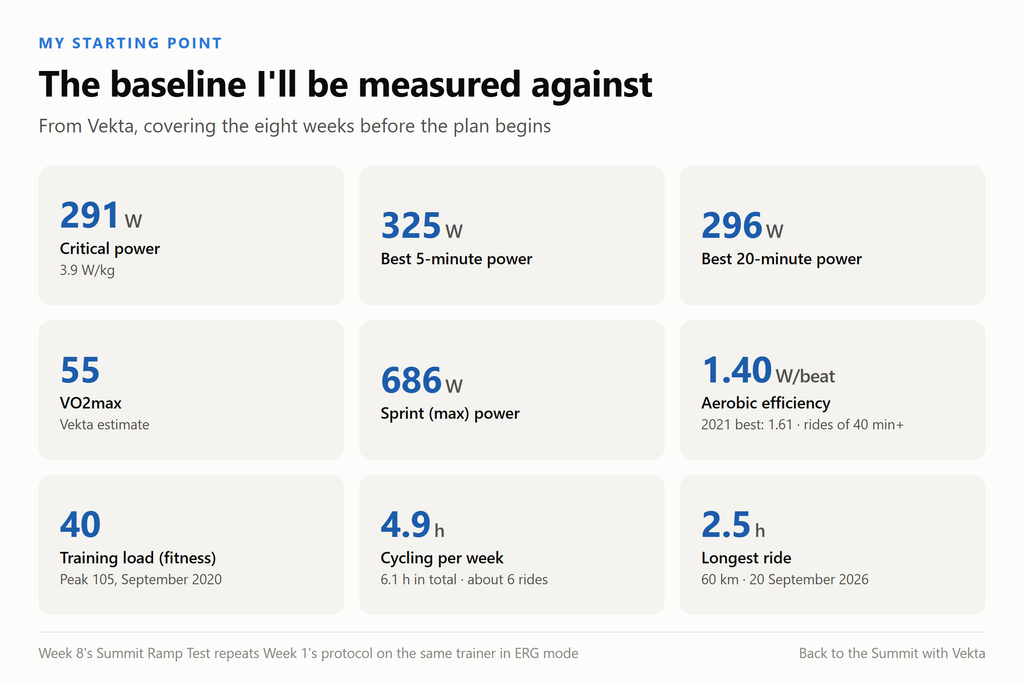
For a fair comparison, the Week 8 Summit Ramp Test repeats the Week 1 test protocol on the same trainer in ERG mode. I will then compare the end-of-plan figures with the baseline data recorded in Vekta.
Conclusion
When I started, I wanted to answer two questions. First, was I fitter before or after cancer? The data gave me a clear answer: I returned fitter than I had been before. The second question is whether I can get back to my previous peak from where I am today. Only the next eight weeks can begin to answer that. What I have now is a measured starting point and a programme built around my own training history, rather than somebody else’s.
What gives me confidence is that much of the decline has been recent, and I have rebuilt my fitness before. In 2021, my critical power rose from 295 W to 351 W in three months. Claude predicts that I could reach around 310–320 W after eight weeks, with a further two to four months of consistent training potentially needed to get back to 350 W. Those are estimates, not promises, but they give me a realistic target to test.
The programme is also designed to keep training enjoyable. There are three focused sessions each week, each under an hour, with the remaining riding built around them. Saturdays bring races and group rides; Sundays mean longer climbs, including Alpe du Zwift, the Watopia Mountain Route and Ven-Top. Vekta will update my critical power, estimated VO2max and training load as I ride, giving me a way to track progress rather than rely on feel alone.
I won’t be doing it alone. From 9 November, the structured sessions will be available as Mountain Massif events on Zwift, with three start times advertised: 6:15 am GMT, 6:15 pm GMT and 6:15 pm MST. Whether you’re returning from illness, injury or simply time away from the bike, you’re welcome to join. Each workout uses percentages of FTP, so its targets scale to different riders. At the end of the programme, we’ll repeat the ramp test and see how far we’ve climbed.
The programme is built, the workouts are in Zwift, and I have eight weeks of training ahead. AI has given me a plan based on my own data and history. But can it actually make me fitter? That’s what I’m about to find out.